Area of work
CARE T’s thematic area of work is in line with the following United Nation’s Sustainable Development Goals (SDGs).
CARE T works on the
Education, Social, Economic and Environmental aspects
- Psychological Care, Guidance and Counselling
- Life Skill Education for children, youth and women
- Human Resource Development Education
- Gender Education in working environment
- Professional Skill Development for better employability and Decent Work
- Job placement after skill development training
- Children Activity Centres
- Educational support to the vulnerable
- Reduction of under-age labour and under-age marriage
- Youth Groups
- Action Groups for sensitization on government poverty alleviation schemes for the welfare of the vulnerable people
- Social Leadership Qualities for the marginalized communities
- Process-oriented Capacity Building for empowerment
- Studies on the social conditions, workers and support for their welfare
- Rehabilitation and Rebuilding of the victims of natural disasters namely Tsunami, Floods, Cyclones and Covid-19 Pandemis
- Environment Education for school children, youth and community
- Restoration of open wells and natural ponds
- Installation of Portable Aqua Unit for Lifesaving – PAUL
- Rainwater Harvesting Utilization Systems in schools and institutions – (RHUS)
- Herbal garden and modern organic school garden for sensitization on native health care
- Revival of coastal ecology for conservation of oceans
- Reduction of dumping plastic wastes and solid waste management
- Training on Low Water Intensive Agriculture for farmers
- Climate Resilient Agriculture and training for farmers on organic farming and sustainable agricultural practices
- Recycling organic wastes as manures and natural pest control measures
- Climate Change Mitigation and Disaster Management
- Studies on environmental status report
- Environment impact assessment
- Environment and Social assessment
- Environment Atlas for river basins
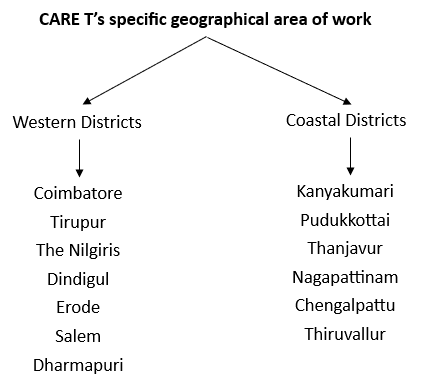
CARE T has its geographical foot prints in 35 districts of Tamil Nadu.
CARE T works for
Marginalized communities,
Unorganized Workers’ communities,
Farmers and Fisher communities
Socio-economically Disadvantaged people
Urban poor